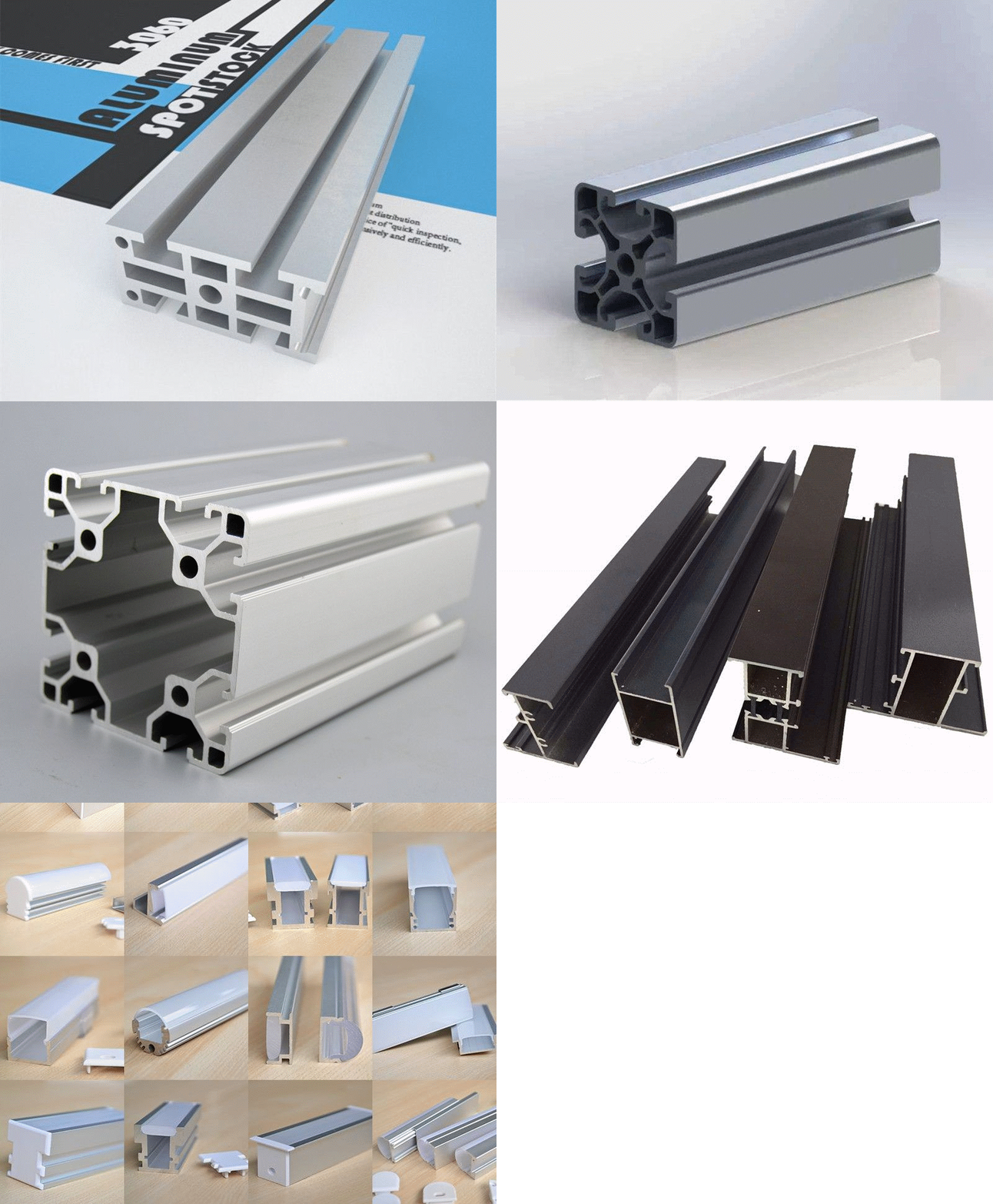
What is aluminum extruded profile?
Aluminum extruded profiles are made by heating and melting aluminum, and then extruding it into aluminum alloy materials with different cross-sections. The main component is aluminum. The mechanical properties and application fields will vary depending on the proportion of aluminum added. The smoothness of aluminum extruded profiles is also the same. The three main surface treatments for aluminum extruded profiles are anodizing, electrophoresis, and powder coating.

Manufacturing process of aluminium extrusion profile
Why choose aluminum extruded profiles?
corrosion resistance
The density of aluminum extruded profiles is about 2.7g/cm3, which is approximately equivalent to steel, copper, or brass, with densities of 7.83g/cm3 and 8.93g/cm3, respectively. Aluminum has good corrosion resistance in most situations, such as air, water, salt water, oil, and other chemicals.
conductivity
Aluminum extruded profiles are widely used due to their excellent conductivity. At the same weight, the conductivity of aluminum is close to half that of copper.
thermal conductivity
The thermal conductivity of aluminum alloy is about 50-60% of that of copper, which is beneficial for manufacturing heat exchangers, evaporators, heating appliances, cooking utensils, car cylinder heads, and radiators.
non-magnetic
Aluminum extruded profiles are non-magnetic and very important for the electrical and electronic industries.
Non spontaneous combustion
Aluminum extruded profiles do not ignite, which is crucial for applications related to handling or contact with flammable and explosive materials.
workable
The processing performance of aluminum extruded profiles is very good. The processing properties of many other deformed aluminum alloys and cast aluminum alloys, as well as the states of these alloys after production, undergo significant changes. Therefore, special machine tools or technologies are required.
formability
The variation of allowable deformation is controlled by the special properties of aluminum extruded profiles, such as tensile strength, yield strength, ductility, and related work hardening rate.
Recyclable
Aluminum has high recyclability. The performance of recycled aluminum is almost the same as that of primary aluminum.

Type of Aluminium Extrusion Profile
What surface finish can we choose for aluminum extruded profiles?
1. Anodizing: Anodizing is a process of using aluminum as an anode, placing it in an electrolyte, and forming a dense oxide film on the surface of aluminum extruded profiles through the action of the electrolyte.

Anodized aluminium extrusion profiles
2. Electrophoretic coating: Electrophoretic coating is the process of dissolving electrophoretic coating materials in water, electrolyzing them to produce charged particles, which move towards the opposite pole under external force and deposit on aluminum extruded profiles. An electric field occurs and a dense and uniform thin film appears.

Electrophoresis Coated Aluminium Extrusions
3. Powder spraying: Electrostatic powder spraying is the process of placing powder coating into a spray gun and, under the action of compressed air, adhering powder particles to the surface of aluminum extruded profiles through high-voltage static electricity.

Powder Coated Aluminium Extrusion profiles
Why choose these three types of aluminum extrusion profiles for surface treatment?
1. Anodizing: After anodizing, a porous oxide film will appear with a hardness of up to 500HV. The porous oxide film can adhere lubricants and dyes, improving the corrosion resistance and wear resistance of the material surface. The oxide film has good insulation properties and a breakdown voltage higher than 30V/mm. The oxide film has strong high-temperature resistance and can withstand temperatures up to 1500 ℃. Aluminum, due to its excellent adhesion, can be anodized and dyed into various decorative colors. Therefore, anodized aluminum is widely used in industries such as aerospace, electronics, construction of various aluminum extruded profiles, and building decoration.
2. Electrophoretic coating: Electrophoretic coating can reduce pollution to air and water, and because water is a dispersing medium, the amount of solvent added is also very small, so there is no risk of fire. The coating material has a high plating force and can cover the edges and gaps of aluminum extruded profiles, forming a dense and uniform oxide film. And the corrosion resistance of the entire component is also very good. The appearance quality of the electrophoresis part is high, and there is no sagging or solvent condensation on the surface of the aluminum extruded profile. Electrophoretic coating adopts advanced RO recycling system, which can save chemical coatings and reduce environmental pollution. Due to the paint recovery rate of over 98%, the discharge of wastewater is also minimal.
3. Powder coating: Due to the higher molecular weight of the resin sprayed by powder coating compared to solvent based coatings, the surface of aluminum extruded profiles has strong resistance to chemical media. It can greatly save work time and batches, and a single powder coating can achieve a coating of 50-300 μ m. Aluminum extruded products are sturdy and durable due to the sagging and pinhole defects caused by powder coating without solvent based coatings. Powder coating can improve the aesthetic effect of aluminum extruded profiles because it has multiple colors to choose from. The surface quality and pre-treatment quality of aluminum based materials are not as strict as the other two methods.