



|
Stereoscopic Lithography Appearance (SLA)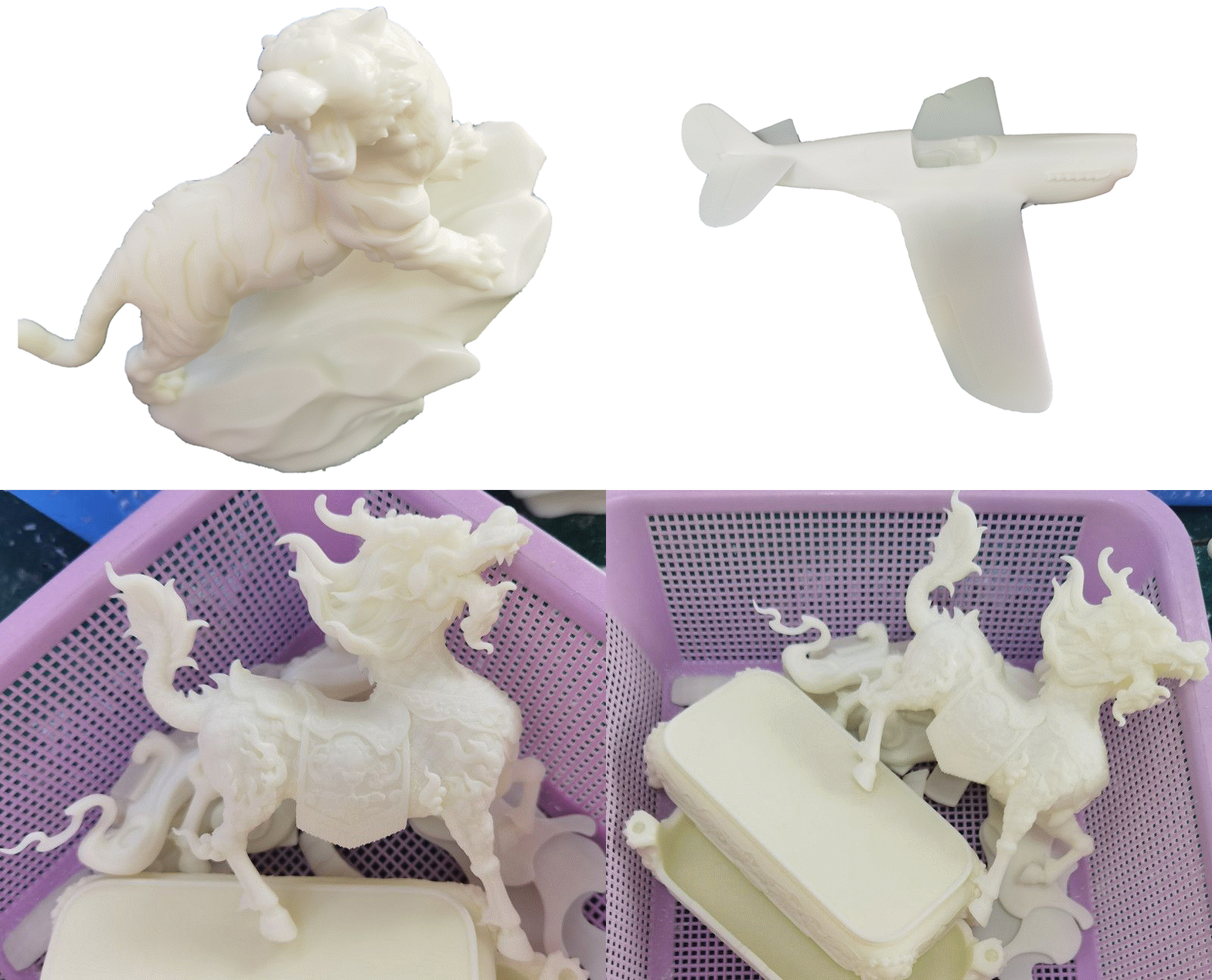    Stereoscopic Lithography Appearance (SLA)Stereo Lithography Appearance (SLA) is the earliest practical 3D printing technology, which uses liquid photosensitive resin as its raw material.
Stereo Lithography Appearance (SLA) What is SLA? SLA stands for Stereo Lithography Appearance. SLA is the earliest practical technology for rapid prototyping, and its raw material is liquid photosensitive resin. Firstly, design a 3D model based on CAD drawings, slice the model using discrete programs, design scanning paths, and generate data that will precisely control the movement of the laser scanner and lifting platform. With the help of a digital system controlled scanner, a laser beam will be directed through a designed scanner path onto the surface of liquid photosensitive resin, causing a layer of resin to solidify in a designated area. After the processing of one layer is completed, the cross-section of the part is produced. Then the lifting platform descends a certain distance, and the solidified layer is covered with another layer of liquid resin. And process the scan of the second layer. The second cured layer will firmly adhere to the previous cured layer. The 3D workpiece will be stacked layer by layer. In order to obtain the desired product, some post-processing is required after removing it from the resin. Such as curing, polishing, electroplating, and painting.
What are the advantages of SLA? Looking at all 3D printing technologies, SLA technology should be the longest developing, most mature, and widely used technology. Stereoscopic lithography systems account for 60% to 70% of the global installation of rapid prototyping equipment. The prototype production speed of SLA is very fast, and the working system is also very stable. Compared with SLS, SLA has higher accuracy and can basically reach the micrometer level. For example, the highest accuracy can be 0.05mm. Of course, if the model becomes larger, the accuracy may be affected. SLA has good smoothness, suitable for some precision and fine parts. SLA technology can also be used to print large-sized prototypes. At present, the largest SLA device on the market can produce prototypes of nearly 2 meters. If your prototype is within 2 meters, it can be directly printed by SLA.
Service Level Agreement Products What are the technical advantages of SLA? 1. Repeatedly creating high-precision components SLA has extremely high accuracy when printing different parts of the same model. Many industries choose SLA printing because it allows for the repeated creation of high-precision components. Compared with traditional machining, the accuracy of SLA is between standard machining and precision machining. Why can SLA replicate high-precision parts? There are two reasons. Firstly, during SLA printing, the heated resin tank and sealed construction environment can provide almost identical conditions for each print. Secondly, compared to FDM thermosetting technology for melting raw materials, SLA uses light instead of heat. So the printing process is carried out at room temperature, and the printing part is not affected by thermal expansion and contraction. 2. Smooth surface treatment SAL printing is considered an excellent standard for surface smoothness, and its appearance can be comparable to traditional processing such as CNC machining, injection molding, and extrusion. The surface quality of SLA is very suitable for the perfect manufacturing industry and helps reduce post-processing time. Because parts can be easily subjected to post-processing, such as polishing and coloring. On the contrary, FDM products have clear and visible layers or lines, while SLS products have granular surfaces from powder sintering.
SLA surface
SLA surface
FDM surface 3. Waterproof performance The printing of SLA is continuous, whether it is producing rigid geometric shapes or parts with internal channels. Therefore, SLA printing has high waterproofing, which is crucial for projects or manufacturing industries that must control and predict air or liquid flow. Engineers and designers can utilize the water tightness of SLA to address the challenges of air and liquid flow in automotive and biological research Limitations of SLA 1. Expensive costs. The cost of SLA system is very expensive, with high usage and maintenance costs. 2. Strict requirements. The SLA system has strict requirements for precision equipment that needs to handle liquids, as well as for the working environment. 3. Difficulty in preservation. SLA prototypes are not suitable for long-term storage because most of these components are made of resin, which has many limitations in strength, stiffness, and heat resistance. When parts are exposed to sunlight, their mechanical performance and visual appearance will decrease over time. 4. Limited available materials. The availability of photosensitive resins for SLA prototypes is limited. In addition, the ductility and strength of SLA prototypes are not as good as CNC prototypes because the buckling position of SLA prototypes is easily damaged. For the above two limitations, special materials can be selected based on the characteristics of the product to solve them. Our professional engineers will provide satisfactory solutions based on the required parameters. 5. A supporting structure is required. SLA prototypes always need to support structures, which need to be removed after the SLA process. This limitation is unavoidable as it is caused by the process principle of SLA 3D printing. But we can minimize the support effect to the greatest extent possible. Due to our professionals' ability to provide the best printing solutions and support structure designs.
support structure Application field SLA printing is widely used in product development, such as automotive, medical, casting models, architectural models, as well as conceptual, geometric, or visual display prototypes. |


